On May 21, 2026, the Canadian Radio-television and Telecommunications Commission (CRTC) released “Part 2” of major regulatory policy, “The Path Forward – Supporting the creation and distribution of Canadian programming in the audio-visual sector”.
BACKGROUND
This policy decision was a part of the CRTC’s implementation of Bill C-11, the Online Streaming Act, a major objective of which is to bring foreign streaming services like Netflix, Amazon Prime Video, and Disney+ into the regulated Canadian broadcasting system. This is to ensure they contribute to the creation and presentation of Canadian programs, just as domestic Canadian broadcasters have long been required to do.
It follows a lengthy CRTC consultation process in which the WGC was actively involved. Our efforts have spanned the last three years, and included: having meetings with the CRTC Chair, Commissioners, and staff; organizing visits by CRTC Commissioners to writing rooms, to meet with screenwriters and showrunners and discuss what they do; organizing and prepping WGC members to participate in CRTC-led CanCon workshops held in multiple cities across Canada; appearing in person in Ottawa in two major public hearings; and, filing written comments in six distinct formal CRTC consultation proceedings, totaling approximately 57,000 words of detailed policy positions, arguments, and supporting data and research. You can read the WGC’s detailed written submissions in that process here and here, and watch our appearance at the public hearing here.
“Part 1” was released in November 2025, and focused on the definition of “Canadian program”, or “CanCon” in the parlance of the Canadian broadcasting system. The WGC provided its analysis of that Part 1 decision here.
ANALYSIS: WINS AND LOSSES
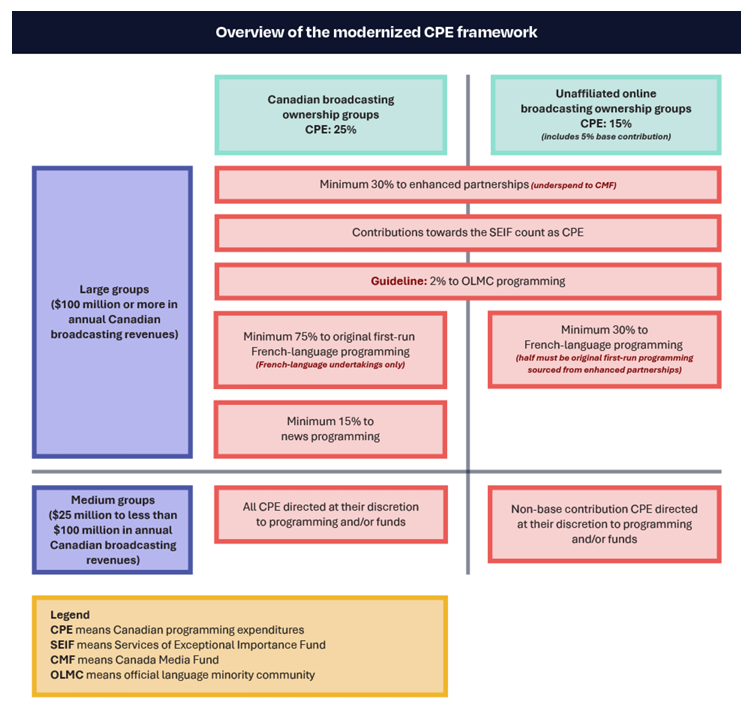
The Part 2 decision, released in May 2026, focuses on the type and amount of investments in Canadian programs that broadcasters and streamers will be required to make. In it, the CRTC has created a new framework for “Canadian programming expenditures” or “CPE” requirements. Private Canadian broadcasters will be required to contribute 25% of their annual Canadian broadcasting revenues to CPE, while the CPE requirement for online streaming services will be 15%, which includes their 5% base contribution requirement established in 2024.
This breaks down further into a matrix of contribution requirements depending on the amount of annual revenues earned by applicable broadcasters and streamers, as well as the types of Canadian programming being supported. The CRTC has provided a graphic showing the “Overview of the modernized CPE framework,” which is reproduced at the end of this article.
The CRTC estimates these requirements will deliver over $2 billion in contributions to Canadian programming. This marks a step in the right direction in the implementation of the Online Streaming Act. The WGC expects this to result in work for members and a boost to the struggling Canadian domestic production sector.
Like the Part 1 decision, the 57-page Part 2 decision adds significant complexity to the Canadian regulatory system. There are questions outstanding, and the WGC is still digging through the details to understand the nuances and potential impacts. At a high level, however, here are some key issues of particular importance to WGC members.
CPE levels
Under the previous regulatory regime, private Canadian broadcasters were subject to a variety of CPE obligations based on their size, nature of service, and whether they were part of a large corporate ownership group. The most important part of that system from the WGC’s perspective was that of the large, English-language groups of Bell Media, Corus Entertainment, and Rogers Media. These three groups each had a CPE requirement of 30% of their annual Canadian broadcasting revenues, resulting in hundreds of millions of dollars worth of spending on Canadian programming annually.
Up until recently, online streaming services had no CPE requirements. This fundamental imbalance was a large part of the regulatory asymmetry that the Online Streaming Act was meant to address. Under the new regime, the large, English-language Canadian broadcasting groups are moving from a CPE of 30% to 25%, and online streamers are moving from 0% to 15%. Given the size and historical growth of online streaming revenues, this seems likely to grow overall CPE levels across the system.
Beyond that general statement, however, it is difficult to say more. We don’t have access to detailed data on streaming services’ revenues, so we cannot know the exact size of that contribution. Questions also exist about how much these revenues might grow or not grow in the current economic climate. The percentages alone indicate a net increase to total CPE spending in the system, but the size and nature of that increase is still unclear.
So, why did the CRTC decide on 15% for the streamers? And why are Canadian broadcasters and streamers subject to a different, 25% requirement?
The CRTC rarely publishes detailed rationales for its policy decisions, and this was no exception. There were no clear and explicit reasons given. Streamers were starting from 0%, and there was no obvious or universally agreed upon level for where they should be. There were international precedents, but they varied significantly above and below 15%, and were grounded in each country’s particular laws and politics.
In our submissions to the CRTC during the consultation process leading up to this decision, the WGC argued that the Commission should realize the public promise made by the then-Minister of Canadian Heritage, Pablo Rodriguez, indicating that $1 billion in annual new spending would result from the passage of Bill C-11. That estimate appeared to be based on streamers matching the historical 30% CPE obligation of the major English broadcasters. We clearly didn’t get that 30% level for them in the end.
While the Commission did not provide a detailed rationale for its numbers, it did speak to broad issues such as “stabilization,” “equitability,” and the challenges currently facing traditional Canadian broadcasters. The CRTC also mentioned section 3(1)(f.1) in the Broadcasting Act, which could be interpreted as setting a double standard for Canadian and non-Canadian broadcasters.
Elimination of the PNI policy
Perhaps the most significant disappointment for the WGC in this decision was the elimination of the PNI policy.
“PNI” stands for “Programs of national interest”, and was a policy that set minimum spending obligations for a subset of CPE in the genres of drama and comedy (which includes children’s and youth programming and animation), long-form documentary, and certain awards shows. These are obviously the core genres in which WGC members work. The large, English-language Canadian broadcaster groups have had specific minimum spending obligations on programs in PNI genres. These were based on their prior historical spending in those genres, and ranged from 5% to 8.5% of their annual broadcasting revenues.
The CRTC has now eliminated the PNI policy going forward. It had signalled its interest in doing so during the consultation process, and the WGC was among many that argued strenuously for retaining the policy. We emphasized that PNI genres have long been recognized as being at-risk, and just as Canadian broadcasters have indicated a desire to move out of that business themselves, largely due to the high cost and risk of their production, so too could foreign streamers. The ability for more expenditures to be directed to Canadian lifestyle, reality television, or other genres to meet CPE obligations is a significant concern.
Once again, the CRTC did not provide a detailed rationale for its decision. It did, however, state in the preceding consultation process that it held as a preliminary view that:
in an “on-demand” system driven by online undertakings whose business models are based on the programs that underscore the current definition of PNI, such as drama and documentaries, the current approach to PNI is no longer needed.
From this, it seems clear the Commission believes that streamers’ business models are based in PNI genres, so if they have a CPE obligation, the CRTC thinks they will naturally direct a reasonable portion of that to Canadian drama, kids’ shows, and documentary.
This is obviously an enormous gamble the WGC would much prefer the CRTC not take, especially when it comes to something so important to both the Canadian broadcasting system and our industry. (The Commission also points to other regulatory tools that it suggests will support PNI, though in the WGC’s view, these other tools are indirect in nature, and not nearly as strong as a direct and specific PNI obligation would be.)
The ray of hope here, however, is that the CRTC claims it is not abandoning its concern for these genres altogether. It says that a diverse range of genres, “are critical to the achievement of the policy objectives outlined in the [Broadcasting] Act,” and that the Commission, “will closely monitor the impact of this decision, and will ensure through future processes, including on tailored conditions of service, that the system continues to support [them]”.
We plan on holding them to that – see more on “tailored conditions of service” below.
Questions remain
While the Part 2 decision answers many questions, it opens – or leaves open – others. Once again, the CRTC has introduced significant additional complexity into the Canadian broadcasting system. This includes: the rearrangement of how broadcasting corporation “groups” work; the interaction of this decision with Part 1, as well as future decisions still to come; and, how broadcasters and streamers will make use of the flexibility within the framework.
WHAT HAPPENS NEXT?
This decision doesn’t end the process for implementing the Online Streaming Act.
More policies are coming
The CRTC also released another policy decision on the same day, entitled “Discoverability of Canadian and Indigenous content and services, and support for services of exceptional importance”. This itself is a “Part 1” decision, of which a second part is still expected, and while it has less direct impact on WGC members – and is outside the scope of this article to address in detail – it will also feed into the overall picture of the modernized Canadian broadcasting system.
Tailored conditions of service and possible implementation timeline
More immediate for our purposes will be the “tailored conditions of service” phase. The CRTC has not released details of this phase yet, but has indicated it will result in requirements for each applicable private Canadian broadcaster and online streaming service, and will involve a public consultation proceeding expected to launch in Fall 2026. The WGC will again be intensively involved in this phase.
The CRTC typically implements major policy decisions in relation to a “broadcast year,” which runs from September 1 through August 31. On that basis, a tailored-conditions-of-service proceeding this fall would suggest a final implementation date of the new requirements no sooner than September 1, 2027.
Court appeals
That said, we know the streamers have strongly opposed this policy decision. Given that, as well as their past behaviour, we can expect them to appeal one or more elements of the decision to the Federal Court of Appeal. That, in turn, has the potential to delay implementation if the Court decides to suspend some or all of the CRTC decision pending the outcome of appeals.
Additional WGC advocacy
As for the WGC’s own immediate next steps, we are carefully examining all avenues. This includes consultation with experts and other stakeholders in our sector.
While we are unhappy with certain elements of this decision, in particular the elimination of the PNI policy, the Guild needs to consider all relevant strategic factors. This includes the immense opposition from the streamers and others to the very foundation of the Online Streaming Act itself, as well as the current trade negotiations between Canada and the United States. Indeed, we feel that bolstering the Online Streaming Act is a high priority right now, so we are currently working with others in our sector on public communications supporting our national cultural sovereignty.
Meanwhile, we will continue to carefully assess what we’ve won, what we’ve lost, and how to best position ourselves in the future battles to come.
WHAT IT TAKES TO MAKE CHANGE
As we said when the CanCon “Part 1” decision was released, it is important to remember that effecting positive change in government and at the CRTC is an immense task that often takes years to see results, with those results usually being incremental improvements rather than game-changing outcomes.
In the public consultation leading to the CanCon decisions, the CRTC received 480 written submissions, of which the WGC’s was one. The CRTC held a public hearing in May 2025 with 78 appearing parties, of which the WGC was one. While many in our sector supported robust CPE levels and maintaining the PNI policy, many others were either indifferent to those views or openly opposed them. The strength of the voice needed to be heard above the din is enormous, yet the WGC has often been heard.
Similarly, the results of our efforts will not be known immediately. These things take time. For example, in the fall of 2020, the Canadian Association of Broadcasters filed an application with the CRTC to have its under-spending on Canadian programming forgiven due to the Covid-19 pandemic. At the time, many considered this application likely to succeed, given the unprecedented nature of the pandemic. But the WGC fought back, arguing the CRTC’s CanCon spending formula meant that what the broadcasters were really seeking was double the regulatory relief for a single (and temporary) revenue decline. The CRTC agreed, citing the WGC’s arguments throughout its decision.
We fought that battle in 2020, the CRTC decision came out in 2021, and we finally saw the impact on WGC member earnings in 2023, with millions of dollars more in screenwriters’ pockets than otherwise would have been the case. That’s three years between action and demonstrable outcome.
Government and regulatory action is a marathon, not a sprint. The WGC is in the race, and we’re winning more than our fair share of the time. We will continue working hard to do so.